
Desired Climate Future of 2041
…The year 2041 marks the grand opening of a new transcontinental high-speed and interstate/city passenger railroad systems in the United States of America...
By Alyxander Kalleberg
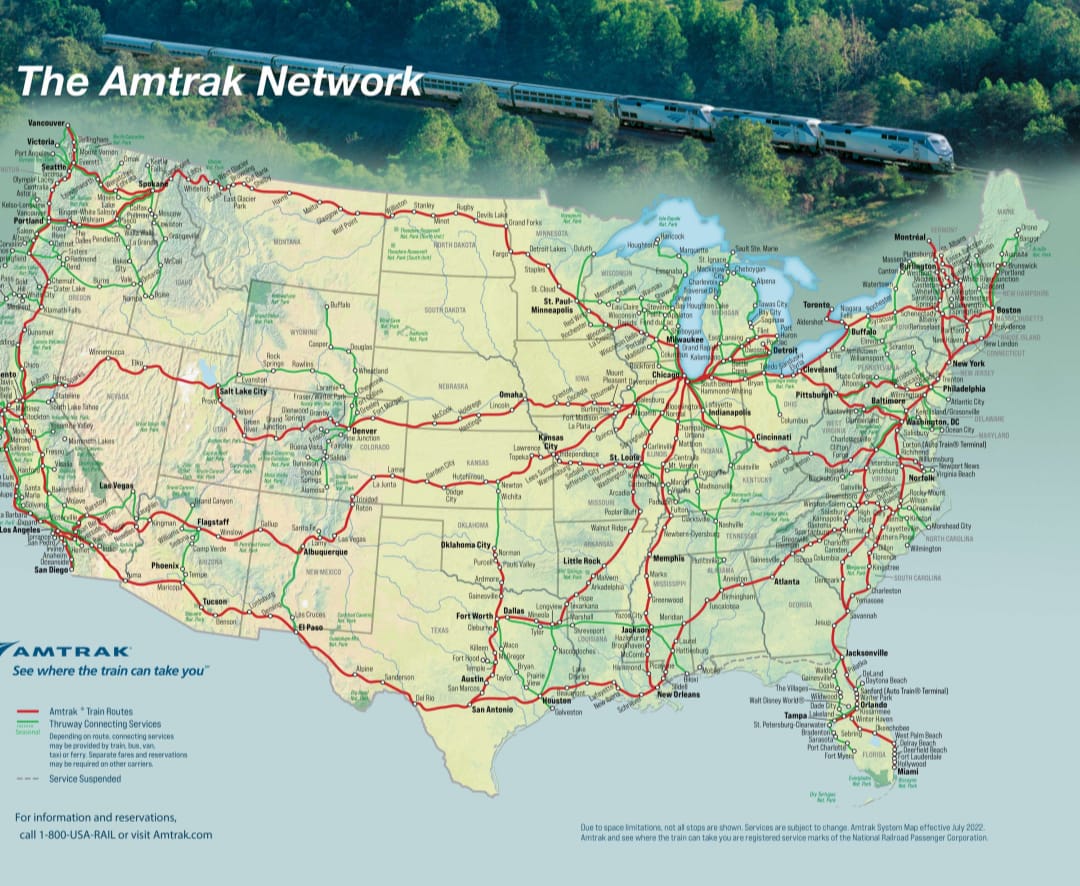
Despite being a global leader in railway construction in the mid 1800’s (1), the United States has been dependent on cars for decades. A small personal example on the subject: the state of Missouri is roughly 480 km (North/South) by 390 km (East/West) and spans a total of 180,500 km2 (6). Yet despite being half the size of Germany (357,600 km2) (3), there are only three passenger rail lines for the entire state. If I wished to visit my parents, the only way to travel the 200 km trip would be by car*, releasing approximately 100 kg of CO2 for a round trip**. While 100 kg may not seem to much on its own, there are hundreds of millions of these communities happening across the United States every data compounding the release of CO2.
This dependency on automobiles in the US is a major component for negative environmental impacts of fossil fuels. Introducing an affordable, fast, and reliable rail network to connect not just inner-state traffic, but connect the whole of the United States. Although I couldn’t find exact data on how much CO2 reduction this could create, if there was even just a transcontinental train for cargo shipping, it would reduce nearly 75% of carbon emissions per shipment according to the Association of American Railroads (8).
This climate future would create a more connected country and give more people an affordable yet fast way to travel around the United States all while reducing the negative impacts of CO2 emissions.
*Note: A bus line is available for this specific journey as well, however local access to the bus terminal still relies on a car to access as well as this mode of transport is deeply unfavored due to the large extra time commitment and high fees to use. This bus line (Greyhound) also does not include the use of electric vehicles and still add to CO2 concerns.
**Math: The EPA estimates that an average passenger vehicle emits 400 g of CO2 per mile or 250 g per kilometer, therefore CO2 = 250g/km x 200km x 2 ÷ 1,000g/kg = 100kg CO2 / km
References:
(1) Delouya, Samantha. “Why Doesn’t the US Have More Passenger Trains? | CNN Business.” CNN, Cable News Network, 25 Nov. 2023, edition.cnn.com/2023/11/25/business/why-doesnt-the-us-have-more-passenger-trains.
(2) DiGiacomo, Emily. “Speeding into the Future: A Closer Look at the Environmental Impacts of High-Speed Rail.” Pace Environmental Law Review, 6 Jan. 2026, pelr.blogs.pace.edu/2026/01/06/speeding-into-the-future-a-closer-look-at-the-environmental-impacts-of-high-speed-rail/.
(3) “Geography of Germany.” Wikipedia, Wikimedia Foundation, 31 May 2026, en.wikipedia.org/wiki/Geography_of_Germany.
(4) High Speed Rail Alliance, www.hsrail.org/. Accessed 1 June 2026.
(5) James, Derrick. “Americans Want More Passenger Rail, but It’s Cut from Presidential Budget.” Environmental Law & Policy Center, 9 Apr. 2026, elpc.org/blog/americans-want-more-passenger-rail/.
(6) “Missouri.” Wikipedia, Wikimedia Foundation, 31 May 2026, en.wikipedia.org/wiki/Missouri.
(7) Transportation for America. “Getting America’s Passenger Rail Back on Track Requires a Radically Different Approach.” Transportation For America, 20 Aug. 2025, t4america.org/2025/07/23/getting-americas-passenger-rail-back-on-track-requires-a-radically-different-approach/.
(8) Union Pacific. “Creating America’s First Transcontinental Railroad.” Union Pacific and Norfolk Southern Combination, 13 May 2026, www.up-nstranscontinental.com/.